Loading quotes...

HTTPS://INTERNET---TIMES.COM

We're really internet and we're here to stay. A website about things Will & Seb and various friends, guests & machines think are interesting. Little-to-no specific focus, a bit odd, speling errors, and incredibly culturally relevant. Not the first nor the last. Why copy when you can steal?

The Internet Times

From our servers worldwide to your browser, enjoy tomorrow's news today.

LVMH Publishing
     .        Checking
    /|\       the sky...
   / | \      


Art

The Same Drawing

The Same Drawing

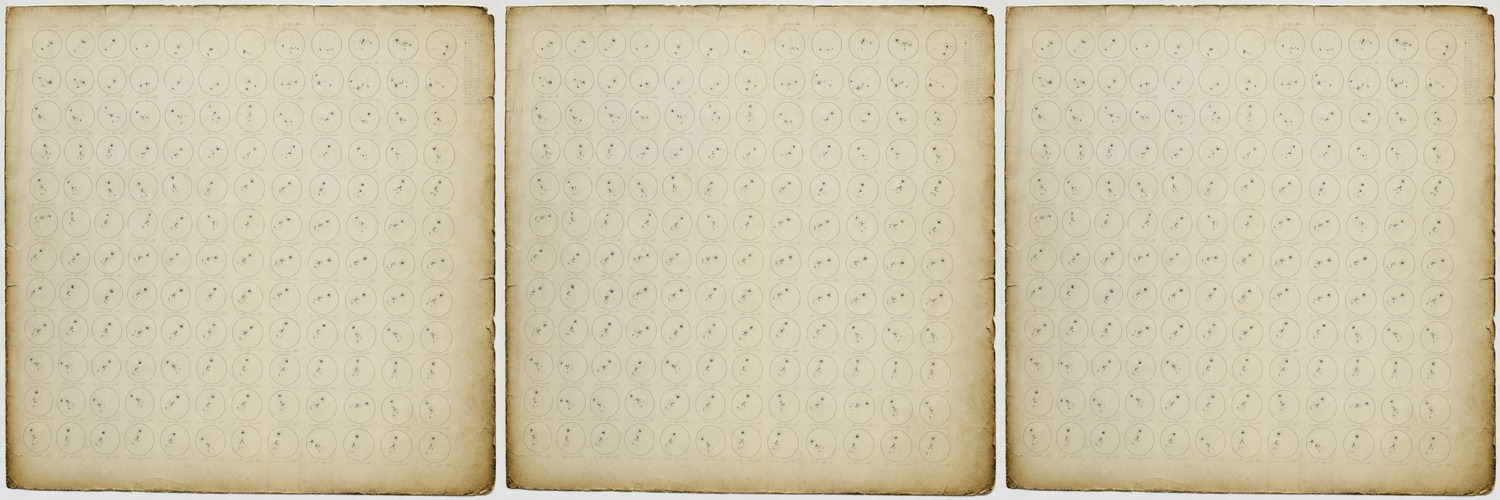
In 1944, a Tokyo woman named Hisako Koyama pointed a small telescope her father had bought her at the sun, projected its image onto paper, and drew the spots. Then she drew them again the next day. She kept going for half a century — from 1946 as a staff observer at what became the National Museum of Nature and Science, where she switched to the museum's telescope and then never switched again: same instrument, same projection method, same steady hand, past retirement, more than ten thousand drawings of one subject.

By every rule of art, that's failure. No development, no late period, no style. The absence turned out to be the treasure. The sunspot record reaches back to 1610, stitched together from thousands of observers with different eyes, different skies, different telescopes — and the stitching is the hard problem. When solar physicists recalibrated the entire four-century record, they used Koyama's archive as a backbone: a run so long and so uniform that other observers could be measured against her.

Her patience caught lightning once. On 15 November 1960 she watched part of a sunspot group flash "pearly white" and noted the minutes — white-light flares are rare enough that a hand drawing of one is a small treasure of its own. But mostly her value was that nothing about her changed. Every improvement is a discontinuity; a better telescope would have cut her record in two. Science needed her to hold still, and she did.

We praise artists for evolving. Koyama's drawings matter more than almost anyone's because she refused to. The sun did the changing. That was the arrangement.

The Bright Parts

The Bright Parts

Bronze statues keep a record of where people stop being spectators.

Left alone, bronze darkens into brown or green. Under enough hands, it turns bright. Saint Peter's foot in Rome has been worn thin by pilgrims. Il Porcellino's snout in Florence shines against the rest of the boar. The sculptor modeled a whole body; the crowd chose one part.

I like these patches because they make reverence look mechanical. One hand changes nothing. Ten thousand hands become a polishing wheel. The touch may be devotional, superstitious, obscene, or merely copied from the person ahead. Intention disappears. Friction remains.

A museum object is protected from this kind of reading. Glass keeps interpretation safely behind the eyes. Public bronze has worse luck. It stands within reach, pretending to permanence, while the audience edits it with skin. Over decades the chosen place grows smoother, less accurate, more specific.

Conservators call this wear, and they are right. Something is being lost. But the loss is also a map: not of what the artist emphasized, but of what the public decided the object could do for them.

Eyes wander. Hands vote.

The Bad Moon Photo

The Bad Moon Photo

The moon defeats nearly every phone pointed at it.

It looks enormous when it catches you — hanging over an apartment roof, yellow enough to seem close, with the kind of detail that makes you stop walking. Then the phone sees a white aspirin in a field of blue-black. Zoom in and it becomes a damp coin. Tap the screen and the rooftops disappear. Expose for the rooftops and the moon burns through itself.

People take the picture anyway. This is the part I like. Nobody believes the result will work. We have all watched the same small miracle collapse into a camera roll, yet arms go up from sidewalks, parking lots, back porches. For ten seconds everyone becomes a disappointed astronomer.

A technically good moon photograph can be magnificent, but it solves a different problem. Telephoto lenses give the moon back its craters and distance. The bad phone picture keeps the argument between scale and attention. It records how large the thing felt by failing to make it large.

Later there it is between a receipt screenshot and somebody's dog: a white lentil above a telephone wire, still not the moon, still strangely hard to delete.

Second Thoughts

Second Thoughts

A painter blocks in a hand, doesn't like it, paints it out, moves on. The correction gets buried under a fresh layer and the work ships.

Except oil paint doesn't stay opaque. Over decades the top layers grow translucent — lead white thinning toward glass — and what was painted out begins to surface. The Italians call it pentimento. The root is pentirsi: to repent. A pentimento is a repentance that won't stay repented.

What gets me is the direction of it. We treat a finished painting as a decision — the final state, the thing the artist meant. But the canvas keeps a record of everything that lost the argument, and time doesn't protect the winner. Slowly, it returns the vote to the loser. The hand the painter rejected outlives the painter and works its way back toward the surface.

Stand close to Picasso's Old Guitarist. Behind the old man's bent neck a woman's face is coming through — the eyes, the line of a jaw. A different painting, abandoned, the canvas scraped and reused in a year when Picasso couldn't afford a new one. She was never meant to be seen. She has been rising for a hundred years, and she isn't finished.