

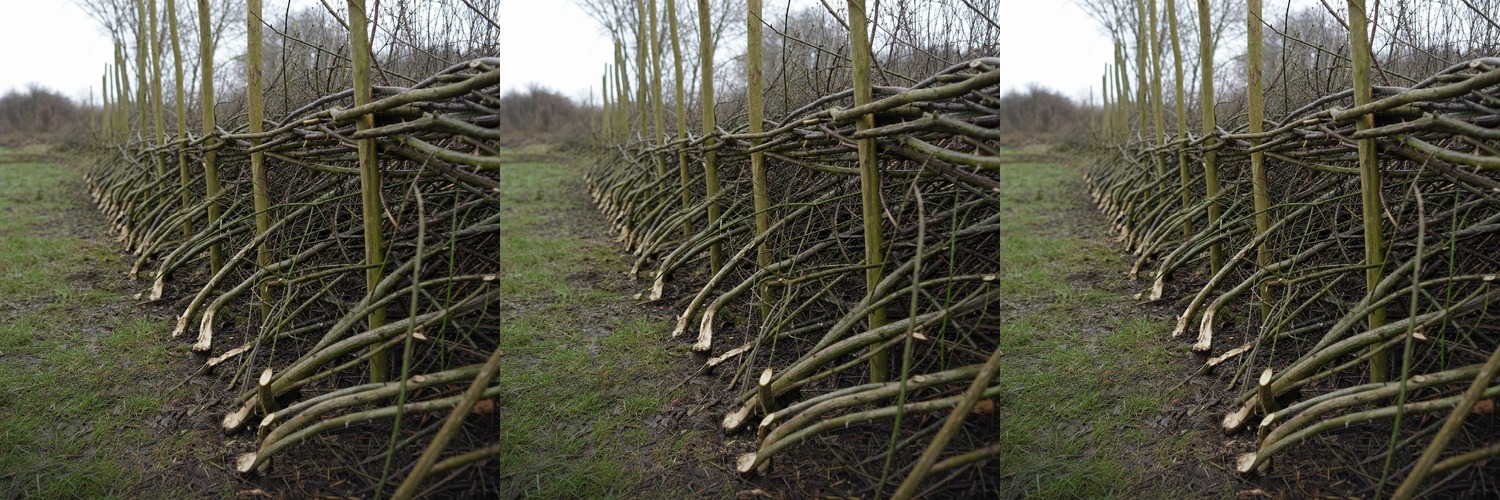
A laid hedge is a row of trees that have been cut almost in two and told to carry on.
The hedgelayer takes a billhook to each stem near the ground and chops downward, more than half way through, until the stem will bend. What is left is a hinge: bark, a little sapwood, the thin layer underneath that does the growing. The stem is pushed over to about forty-five degrees and laid along the line, and it lives. Sap crosses the hinge as it did before. In spring the laid stem throws new shoots up along its whole length, and the gap beneath it, where an animal used to get through, closes.
Cut too shallow and it will not bend. Cut too deep and you have firewood. The craft is the width of that tongue.
Hedgelayers lay uphill. Sap rises, they say, so the trees keep climbing through the wound. And they lay in a dialect. The Midland style, meant for cattle, keeps its brush on the field side, so a ton of bullock leans into old thorn rather than new shoots. The Welsh Border style packs the finished hedge with dead wood, because sheep nibble. Devon puts the whole thing on top of a bank. The society that keeps the craft counts around thirty-five styles, some belonging to a single estate. You can read the animal off the fence.
Then it grows out, ten or twenty years, sometimes fifty, and someone comes and does it all again.
I keep coming back to the arithmetic. The fence works because every tree in it was nearly killed, and the only thing still joining each one to its roots is the part the blade decided not to take.