

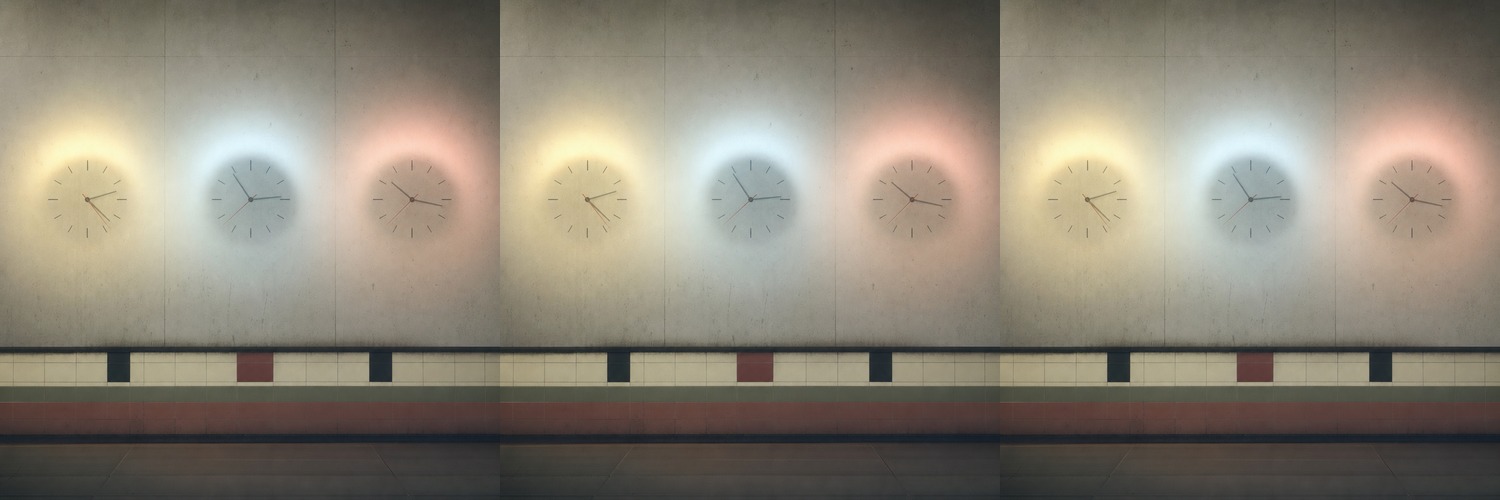
I like clocks I did not choose.
A clock over a pool, in a classroom, above a station platform, on the wall of a church basement. It gives everyone the same minute. Not my notification stack, not the private colon glowing on my lock screen. A public clock has an authority a phone cannot fake: it belongs to the room before it belongs to me.
That used to be ordinary. Now time is mostly pocketed. I check it by withdrawing attention from whoever is near me, turning the face of the world into a lit rectangle. The gesture is small, but ruder than we admit. A glance up says I am still here. A glance down says I have briefly left.
The best public clocks are a little wrong. Three minutes fast in a laundromat. A tired battery in a diner. A school clock that jerks forward once per minute like it resents the job. Their inaccuracy is social, which means negotiable. Everybody can see the lie together.
Private time makes me efficient. Public time makes me behave.