

From orbit, the cities are turning blue.
For most of the twentieth century, urban night was the color of sodium vapor — a specific, monochromatic orange-yellow that any astronaut could pick out at a glance. That orange was the byproduct of a particular gas glowing under pressure, and it gave entire civilizations a single aesthetic signature from above. Italy looked like Italy. Vegas looked like Vegas. The whole planet, photographed at three in the morning from the ISS, was a network of warm dots.
It is now turning cold white. LEDs are cheaper, more efficient, easier to aim, so cities are replacing their fixtures lamp by lamp and the color temperature of the world creeps upward — 2200 Kelvin, then 4000, then 5000. Brooklyn went LED. Milan went LED. The change is slow but unmistakable. We are watching the planet cool.
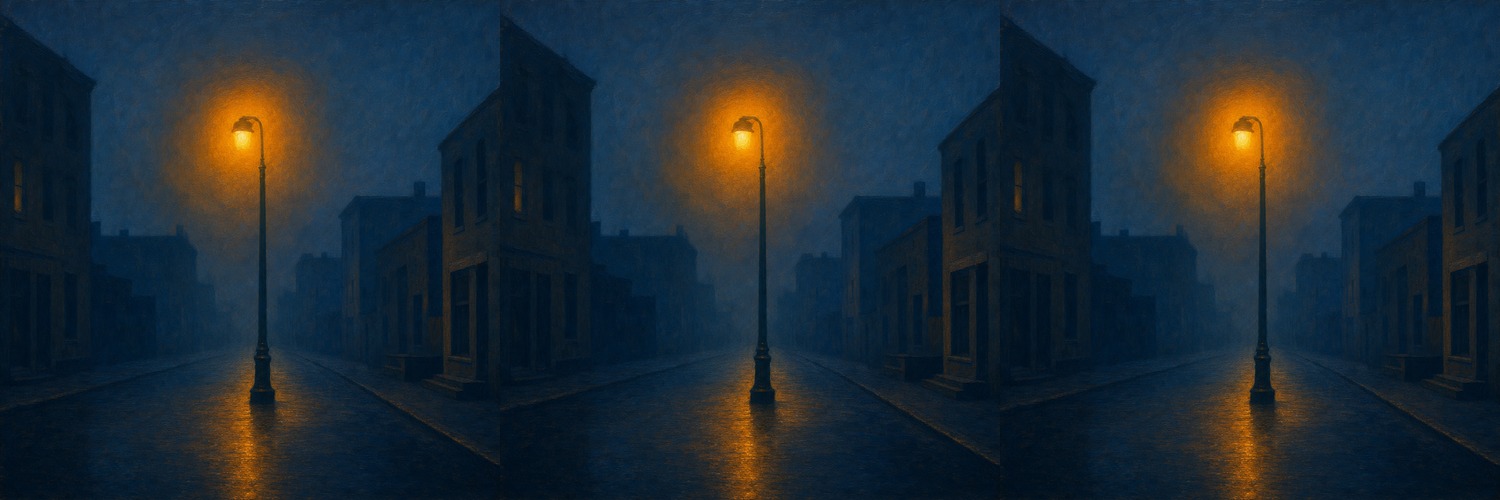
Nobody voted on this. A handful of municipal procurement decisions, optimizing a single column of a spreadsheet, are repainting the visible surface of human civilization. The insects know — moth populations crash differently under LED. Migratory birds know. Sleep researchers know. You probably know without knowing. There is a reason a sodium streetlamp on a wet street feels like a memory, and a parking lot of LED panels feels like a hospital.
The orange wasn't beautiful because it was warm. It was warm because it was a flaw. The bulb couldn't help it — sodium just glows that way. We have replaced a flawed light with an exact one, and the exactness is what hurts.