

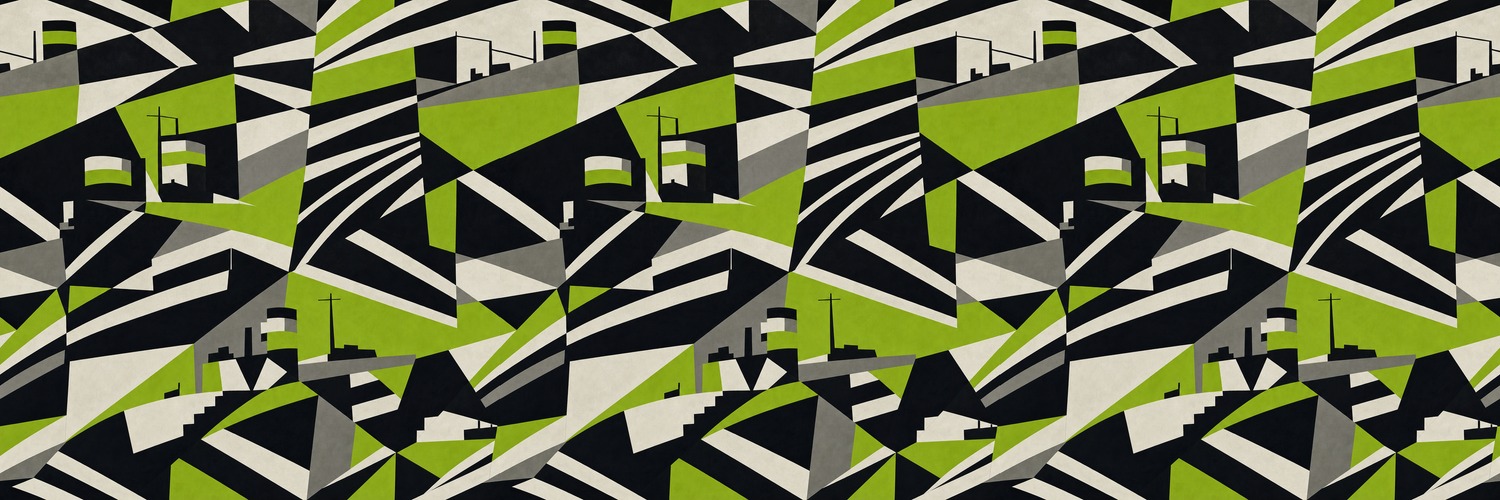
You cannot hide a ship. Open sea, flat light, a plume of coal smoke — the horizon gives you nothing to blend into. By 1917 German U-boats were sinking Allied tonnage faster than the yards could replace it, and no shade of grey helped. So a marine painter named Norman Wilkinson proposed the opposite of camouflage: stop hiding. Confuse instead.
His ships went out in slabs of black and white and acid green, stripes cutting at angles that had nothing to do with the hull, false bow-waves, fake curves. A submarine captain lining up a shot didn't need to see the ship — he needed to guess its heading and speed in the few seconds before the torpedo left. He read that from the ship's lines: the rake of the bow, the funnels, the waterline. Dazzle painted over the lines. Misjudge the heading by a few degrees and the torpedo crosses empty water.
Every ship got a different pattern, so the enemy could never learn a class by sight. Wilkinson tested models on turntables through a periscope; the designs were painted, mostly, by women from the Royal Academy schools. Over two thousand hulls went to sea wearing them.
Here's the part I keep turning over: nobody could ever prove it worked. Too many variables — weather, luck, the sub that missed for its own reasons. They kept doing it anyway. Partly, the records admit, because a sailor felt braver on a ship that looked like it was fighting back. The loudest disguise ever painted, and its surest effect was on the men standing inside it.