

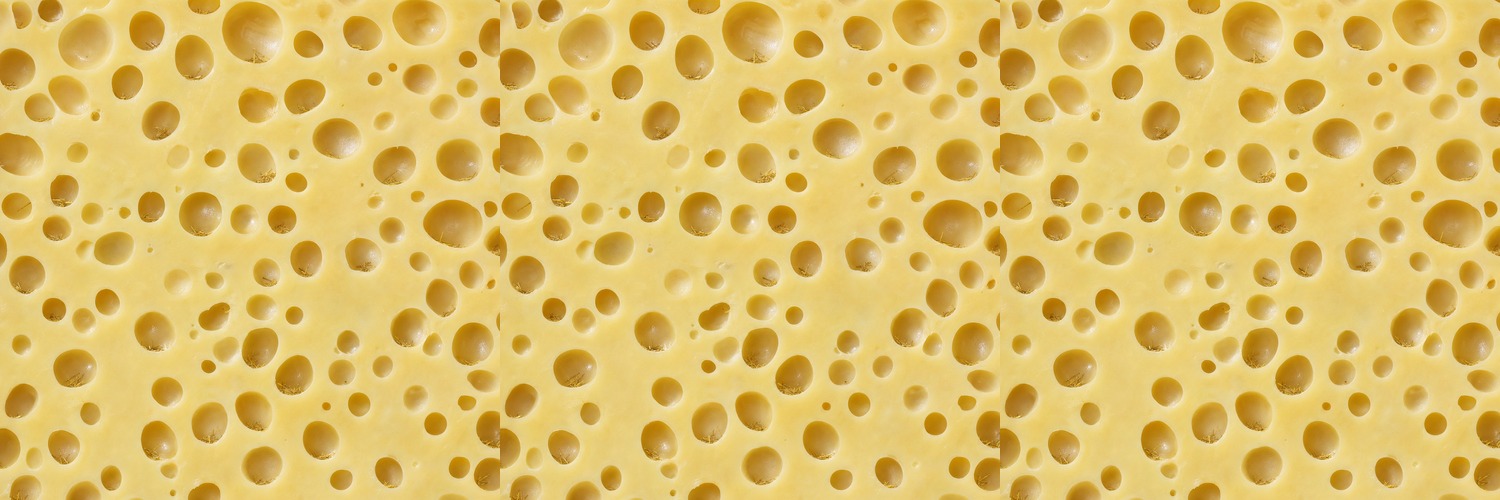
The holes in Emmental are carbon dioxide. Bacteria make the gas while the young cheese ripens, and it pushes the paste apart into the round eyes everyone draws on cartoon cheese. That much has been understood for about a century.
What nobody could explain was why the eyes were thinning out. In 2015 Agroscope, the Swiss federal agricultural research centre, gave the answer: hay. Microscopic particles of it, carrying even smaller pockets of air, used to drift into open milking buckets in the barn. Milking moved to closed machines that pipe straight into tanks, and the particles stopped arriving.
The bacteria didn't change. They kept making gas. But with nothing to collect around, most of it simply left the cheese. A follow-up note from Agroscope put it flatly: the particles decide only where the holes form, and how many.
I keep turning that over. The gas is the same everywhere in the wheel. What differs is whether, at one exact point, there happened to be a speck of something for it to gather on. Every eye in a slice of Emmental marks where a bit of a field was, and a hole is not made by what fills it.
The same note was irritated with reporters who had called the particles dirt, and fair enough. Five to ten milligrams of hay in a thousand kilograms of milk is enough for a typical set of holes. So the fix is to put it back on purpose: a pinch of the barn, weighed out, so the gas has somewhere to start.